
What is Tencel™ Lyocell and Why Did I Choose It?

The perfect black dress for petites but made ethically using sustainable materials like plastic-free Tencel™ Lyocell. This is Birdie.
‘The materials used in making a dress are as crucial to my goal of transparency and traceability as the drape and fluidity of the finished piece. Natural trims were non-negotiable, and the largest decision was the cloth and its origin.’
When I began sourcing fabrics for my first collection, I had a list of requirements that most suppliers could not meet simultaneously, and to me, the fabrics you choose matter just as much as the silhouettes. It had to drape fluidly, in the way that makes a maxi dress move rather than hang when the breeze catches it. It had to be traceable, natural in origin with no synthetic content to ensure my commitment to skin-safe, non-toxic, endocrine-disrupting fibres was met.
Tencel™ Lyocell (Micro) met those requirements. This post explains exactly what it is, how it behaves, what its environmental credentials actually mean, and how blockchain traceability makes it one of the most verifiable fabric choices an independent petite brand could make right now.
What is Tencel Lyocell?
Tencel is a trademarked brand name owned by Lenzing AG, an Austrian fibre manufacturer known for its superior quality and strict environmental standards that has been producing wood-based cellulosic fibres since 1938. Lyocell is the fibre type, regenerative cellulosic fibre made from wood pulp, most commonly fast-growing eucalyptus, harvested from FSC-certified sustainably managed forests. Making it a premium, eco-friendly fibre.
There’s a key distinction that matters here: all Tencel Lyocell is lyocell, but not all lyocell is Tencel. Generic lyocell can vary enormously in quality, environmental standards, and traceability, and these fibres are known to be found in the ghost fabric trade. Tencel specifically requires FSC or PEFC-certified wood sources, a closed-loop production process, Oeko-Tex Standard 100 certification, and Lenzing's own DNA-like fibre identification technology embedded at the point of production. When you see the Tencel name on a fabric, you’re seeing a claim that is independently audited and physically verifiable, not an unverifiable marketing claim or greenwashing tactic.
Who is Lenzing?
Lenzing AG is an innovative Austrian textile company that acquired and ultimately perfected the modern closed-loop manufacturing process for Tencel. They are the unrivalled global gatekeepers of sustainable wood-based fibres, ensuring that no one can legally use the Tencel name unless the fabric meets their rigorous environmental and structural criteria.
Founded in 1938 in the Austrian town of Lenzing, the company initially began as a traditional pulp and paper factory. While the early foundations of lyocell chemistry were developed by researchers at American Enka and later brought to commercial market by the British firm Courtaulds under the name "Tencel" in the late 1980s, Lenzing ran a parallel track of intensive wood-based fibre research. Following a series of historic patent battles and cross-licensing agreements, Lenzing eventually acquired the Tencel business in 2004. Over the decades, they transitioned from regional manufacturers into global pioneers of eco-responsible fashion, scaling and patenting the highly complex industrial spinning processes that made modern, closed-loop Tencel Lyocell commercially viable on a global level.
How does Tencel Lyocell Micro feel?
For the first dress in the collection ‘Birdie’ - the specific composition is Tencel Lyocell Micro, a finer variant with a fibre titre of 0.8, meaning the individual fibres are extraordinarily thin. This composition is considered the highest tier of this fibre. TENCEL™ Micro uses incredibly fine, ultra-lightweight filaments that undergo a specialised finishing process which can be described as a micro-fuzz complexion that feels like peach skin or premium washed silk or sand-washed texture, completely matte, deeply luxurious, and velvety against the skin, while retaining an effortless, fluid drape that doesn’t cling. For comparison, standard lyocell fibres can feel wonderfully smooth but much more structurally flat.
Let’s break down more about why this miracle fabric is a game-changer for modern fashion.
Is Tencel Lyocell a natural fibre?
Tencel Lyocell is a man-made cellulosic fibre derived from wood pulp of sustainably grown eucalyptus trees and other certified woods, but it undergoes a manufacturing process using the solvent NMMO (N-methylmorpholine-N-oxide). Unlike traditional natural fibres like cotton or linen, it is dissolved and extruded rather than grown and spun. While not a natural fibre in the conventional sense, it is the most responsibly produced fibre available that meets the garment’s drape requirements. It is biodegradable, compostable, and entirely free from synthetic or plastic. The production process is among the most environmentally responsible in the textile industry, combining transparency about its nature with confidence in its selection.
How is it made and why does the closed loop process matter?
Tencel Lyocell has a fundamentally different environmental footprint compared to standard viscose, which involves harmful chemical processes, or conventional cotton, which demands significant water and pesticide inputs unless organic. The eucalyptus trees used are rapidly growing, require no irrigation beyond rainfall once established, and need no pesticides. They are cultivated on FSC or PECF-certified plantations, ensuring forestry practices are audited for environmental and social responsibility.
The production employs a closed-loop process where wood pulp is dissolved in NMMO solvent, extruded through fine spinnerets to form fibres, then washed and dried. The solvent is recovered and reused at a rate of 99.8%, resulting in minimal environmental release during production. This process yields a fibre with a significantly lower environmental impact than conventional cotton, in terms of water use, chemical input, and land use, produced from a renewable raw material, biodegradable at the end of its life, and manufactured in a process that returns almost everything it uses.
Processing steps:
1. Chipping: Wood from certified forests is harvested and chopped into small chips.
2. Pulping & Dissolving: The wood chips are purified into sheets of dissolving wood pulp to isolate the raw cellulose. This dry pulp is then broken down and completely dissolved using a non-toxic organic solvent.
3. Spinning: The honey-like mixture is pushed through tiny holes (spinnerets) into a water bath, instantly hardening it into fine threads.
4. Recycling: Over 99.8% of the water and solvent is captured and reused for the next batch, creating virtually zero chemical waste.
Is Tencel Lyocell a natural fibre?
Not in the traditional sense. It is a man-made cellulosic fibre — derived from natural wood pulp but produced through a manufacturing process. It is not synthetic or plastic. It is biodegradable. The Petite Cartel is transparent about this distinction because honesty about materials is central to what the brand is.
Does Tencel Lyocell shrink?
Tencel Lyocell can shrink if washed incorrectly. Avoid tumble drying. Iron inside out on a low heat. Treated correctly, it will hold its shape and drape beautifully for years.
Is Tencel Lyocell plastic-free?
Yes. Tencel Lyocell contains no synthetic plastic fibres. It is a cellulosic material derived from wood pulp. It does not shed microplastics when washed. For The Petite Cartel, this was a fundamental requirement — and it is why Tencel Lyocell, rather than any recycled synthetic, was the only fabric under consideration for Birdie, the first dress The Petite Cartel will launch with.
Tencel Lyocell vs. Organic Cotton
While organic cotton is a massive upgrade from conventional cotton, Tencel Lyocell outperforms it across several performance and design metrics.
That’s not to say organic cotton isn’t good, it’s just to say that the two perform differently. Tencel has a fluid drape whereas cotton is more structured and textured. Tencel has less environmental impact through its water consumption; however, both fabrics have comparable overall environmental credentials.
For drape and fluidity, yes, Tencel Lyocell outperforms cotton significantly. For environmental impact, Tencel uses less water, fewer pesticides, and a more responsible production process than conventional cotton. Organic cotton has comparable environmental credentials but does not achieve the same drape or hand feel. They serve different purposes, and the right answer depends on what the garment requires. For the classic black dress I intend to launch with, drape was the primary design requirement- which made Tencel the clear choice.
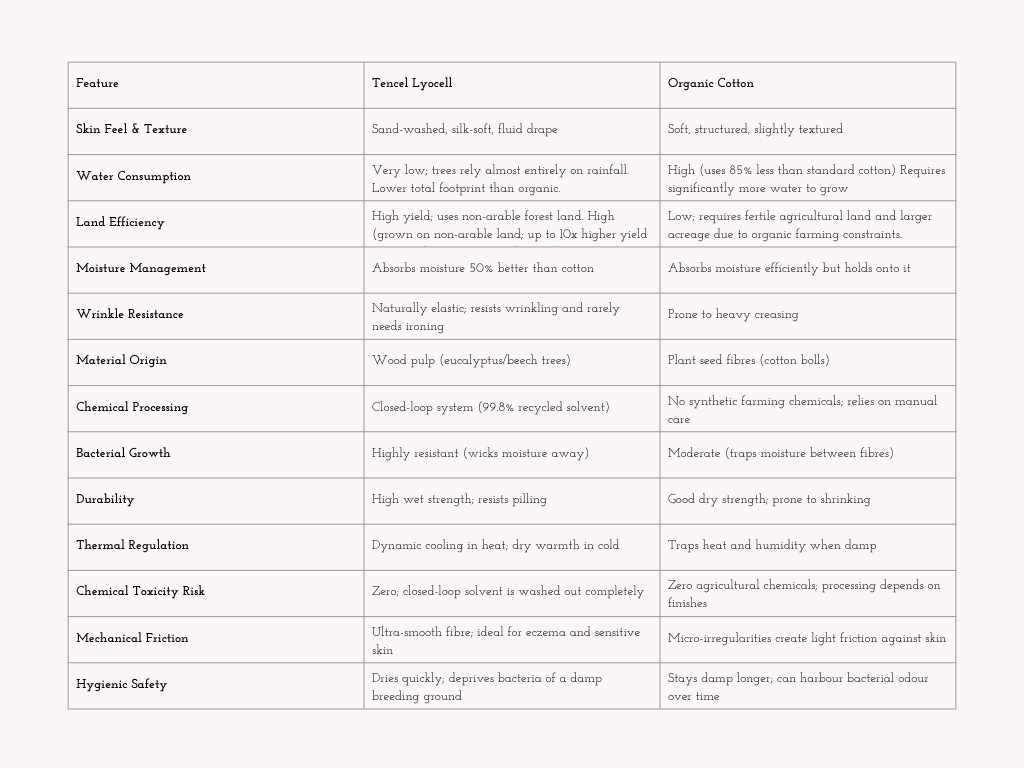
Comparing key features of Tencel with Organic Cotton
Forensics in Fashion: The Un-Tamperable "DNA-Like" Blockchain Inside the Fabric
The fashion industry has a dark secret: the market is flooded with cheap, generic "ghost fabrics" pretending to be luxury, sustainable materials. To combat this, Lenzing has pioneered the field of forensics in fashion, turning your clothes into a high-tech tool for truth. When my Lenzing agent sat down with me, they revealed something mind-blowing. Every single thread of genuine Tencel™ Lyocell is embedded with its own unique, microscopic DNA-like marker and tracked via the un-falsifiable TextileGenesis™ blockchain. This system relies on an innovative technology called Fibercoin™, which issues digital tokens in exact proportion to the physical shipments of raw fibre. Think of it as a permanent, un-copyable digital twin or birth certificate woven directly into the physical makeup of the fabric itself. Because these digital tokens must move forward along the supply chain alongside the physical yarn, the ledger cannot be washed out, faked, or tampered with.
Lenzing takes fake fabric so seriously that they aggressively police their trademark. Before a brand can legally print a Tencel™ label or claim a garment is "100% Tencel," they must submit physical fabric samples to Lenzing’s specialised laboratories. Scientists run forensic tests to verify the exact presence of that physical DNA-like marker. If a value chain partner attempts to swap in a cheap, counterfeit alternative, Lenzing’s verification platform flags the missing Fibercoin balance immediately, blocking their certification. When you buy from our petite collection, you aren't just buying a fabric—you are buying bulletproof authenticity verified by physical science and digital ledger systems.
Skin Safety: Dyes, Toxins, and My Personal Fight Against Plastic
Many fashion-conscious buyers ask: are the dyes and treatments used in Tencel™ Lyocell toxic to the skin? No. True Lenzing Tencel™ is certified non-toxic and holds the OEKO-TEX® STANDARD 100 certification, which rigorously tests for over 1,000 harmful chemicals, including endocrine disruptors, PFAS, and heavy metals. Because all the fabric samples for this collection are completely verified under this rigorous standard, you can be certain that every square inch touching your skin is entirely safe. Furthermore, because Lenzing utilises an advanced, totally chlorine-free (TCF) oxygen process to purify the raw wood pulp, it completely avoids the aggressive, toxic chemical bleaching cycles required by traditional textile crops.
This clean profile is personal and important to me. My journey into building a plastic-free, conscious alternative started when severe chronic inflammation forced me to completely overhaul my lifestyle and my wardrobe. Wrapping myself in petroleum-based polyester just didn't feel safe anymore and although I didn’t through everything out overnight, I have worked hard to remove most toxic materials from my everyday life.
As highlighted in the groundbreaking documentary The Plastic Detox, plastic-based textiles like polyester, nylon, and acrylic are created from crude oil. When we wear these synthetic fabrics, our natural body heat and sweat cause our skin pores to open. This close contact allows the residual synthetic chemical treatments and plastic additives to absorb straight into our bodies. The health data presented in The Plastic Detox reveals that constant exposure to synthetic garments triggers microplastic and chemical absorption inside human tissue, directly fueling global spikes in hormone disruption, infertility, and heightened disease risks. By choosing Tencel™, we are rejecting plastic fashion and keeping our skin safe.
Is Tencel™ Lyocell Sustainable and Why?
Yes, Tencel™ Lyocell is one of the most sustainable fabrics on Earth due to its closed-loop production, FSC-certified wood sources, near-total solvent recovery, biodegradable end-of-life, and independent certification through Lenzing’s E-Branding system.
It is not a traditional natural fibre, but its environmental credentials are significantly stronger than conventional cotton, standard viscose, or any synthetic alternative.
The 99.8% chemical solvent recovery loop keeps processing components entirely contained within the factory and out of our precious waterways.
Lenzing processes its fibres using high rates of renewable bio-energy, drastically reducing carbon emissions compared to fossil-fuel-reliant polyester.
Because it is made from pure plant cellulose, a pure Tencel™ garment can completely compost back into the earth at the end of its life cycle, leaving absolutely no persistent microplastics behind.
Final thoughts
Tencel™ is a wonderful alternative to petroleum-based synthetic fibres, offering performance qualities that truly rival natural materials. Its blockchain network provides a powerfully traceable method for total accountability, and its drape speaks for itself. I’m so looking forward to utilising this fabric for future styles- it’s the perfect foundation for a sustainable, conscious petite brand.
Mintu,
Founder | The Petite Cartel

IN THIS POST
* What Tencel™ Lyocell is: and why Tencel™ specifically is different from generic lyocell
* Who Lenzing: an introduction to the Austrian manufacturer behind the material.
* How Tencel™ Lyocell Micro feels: describing the sand-washed, dry silk texture.
* Is it a natural fibre?: an honest breakdown of how the textile is classified.
* The closed-loop process: how it is made and why the production system matters.
* Tencel™ vs. Organic Cotton: comparing the drape, performance, and use cases of both fabrics.
* Blockchain inside the fabric: how technology traces your garment from origin to finished piece.
* Skin safety and toxins: a personal perspective on chronic inflammation and moving away from plastic clothing.
* Why Tencel™ is sustainable: the facts behind its environmental credentials.
* Quick answers: clear details on fibre origins, shrinkage, and its plastic-free status.
The Petite Cartel is a UK-based womenswear brand designing plastic-free, natural fibre clothing made specifically for petite bodies. Every garment is made to order by limited drops in the UK with traceable, responsibly sourced materials, including every trim, label, and fastening.
If you’ve enjoyed this read, follow The Petite Cartel on socials for future updates and join the waitlist for early access.
Sources: Tencel™ Lyocell Explained, A history of Lenzing, Tencel Lyocell Processing, Choosing A Responsible Source, Tencel Fibres Explained, Tencel, A Credible Alternative To Cotton, The Dark Side Of Fast Fashion, Blockchain Enabled Supply Chain, Fast Fashion Traceability, Textile Genesis™, OEKO-TEX® STANDARD 100, What is OEKO-TEX, Strange Ways Microplastics May Be Entering You Body, Netflix: The Plastic Detox